Making a crypto payments API safe to integrate
A B2B platform that lets gaming operators accept crypto without running blockchain infrastructure. I made its API contract something an operator can integrate without losing money, then owned the compliance layer (KYC, KYT, Travel Rule) from PRD to scope lock, keeping the platform a data provider rather than a party to the transfer.
- Role
- Senior Product Manager: Operator API, Admin API, compliance
- Client
- A B2B crypto payments provider for gaming operators: payments, compliance and risk orchestration
- Team
- Core engineering, a frontend agency, leadership, custody and compliance vendors
- Delivered
- Contract gap report, integration guide v1.1 to v1.5, integration API architecture, operator portal and dashboard prototypes, production UAT, a live stage and demo environment, compliance and risk layer designed and scope-locked
The situation
The client is an API-first B2B platform that lets gaming operators accept crypto deposits and pay out withdrawals (USDT, USDC and ETH on Arbitrum and Ethereum) without running any blockchain infrastructure. A regulated custodian holds the funds. The platform watches the chain, keeps the ledger, and tells the operator what happened through webhooks and a REST API.
I joined as Senior Product Manager. Three layers had to agree with each other: the core engine with its Operator and Admin APIs, a merchant portal and admin panel built by a frontend agency, and the custodian underneath. Then regulation arrived on the roadmap: wallet screening, the Travel Rule and identity checks for crypto in gambling.
The problem
An operator's engineers build against two documents: the OpenAPI specification and the integration guide. Read side by side, line by line, they disagreed in 24 places. Two were the kind that cost money: an operator following the guide to the letter would reserve the wrong amount for a withdrawal fee, or process a retried request twice. The rest were quieter traps, such as the same field named differently in requests and webhooks, and a status described as final that was not.
For a payments API, the integration guide is part of the contract. If the guide is wrong, the API is wrong.
Compliance raised the stakes. Designed carelessly, it would make the platform the regulated party on every transfer.
What I did
Contract first
I treated the live OpenAPI specification as the contract of record and diffed every statement in the guide against it: endpoints, fields, enums, fee formulas, delivery and retry behaviour. Each disagreement became either a guide fix or a written question for engineering. Anything the specification did not cover stayed an open question, never an assumption.
Test in production, without moving money
Before the operator's go-live I wrote a production UAT pack, ten flows from funding a site to settlement and exports, and ran the first pass myself on the live portal with no funds moved. It found seven issues. The one that mattered: withdrawal limits were configured per chain, while the documentation promised one limit per coin across both chains. An operator who believes a limit covers two networks when it covers one has real, avoidable exposure.
A stage environment that can reach every state
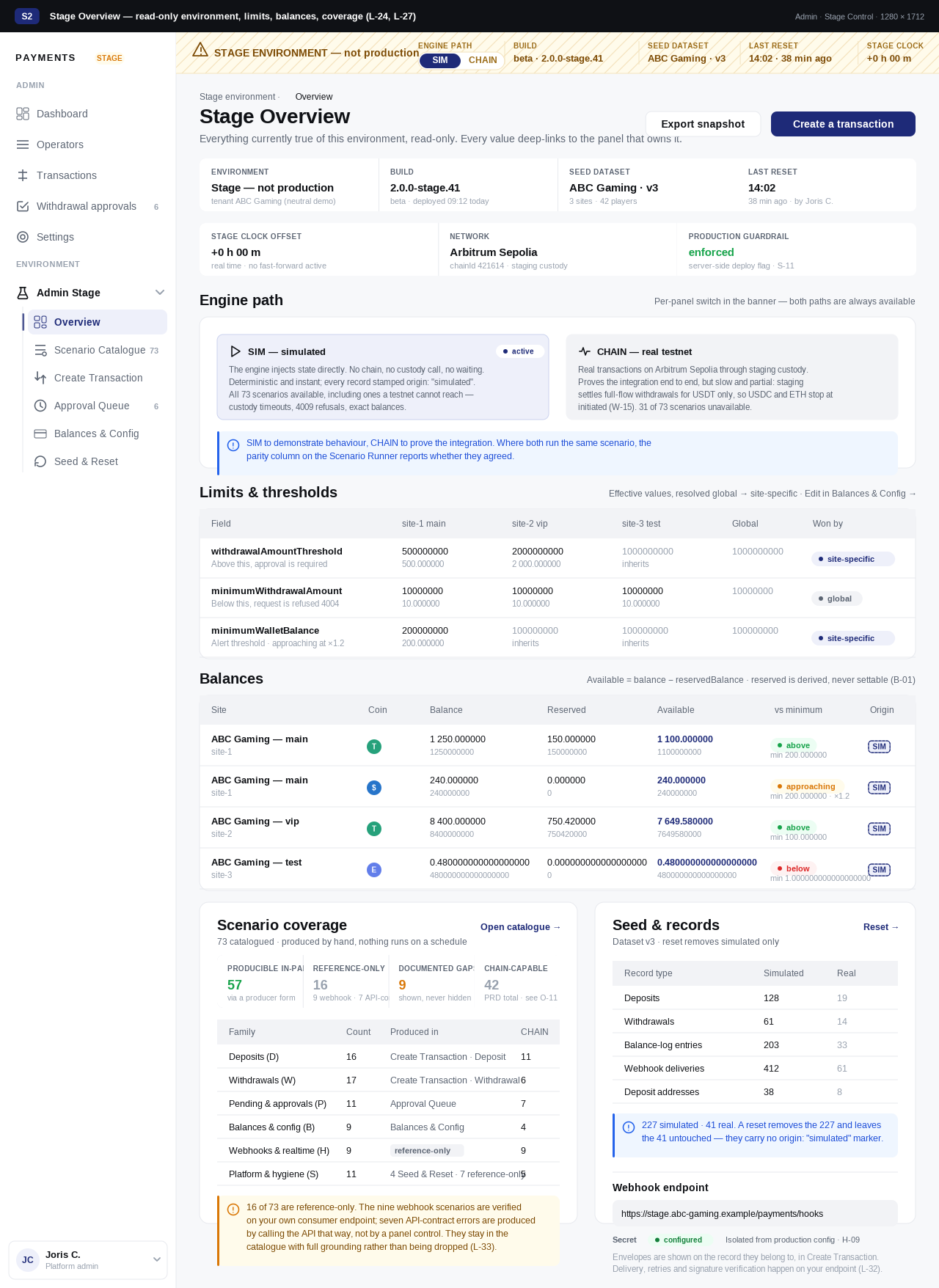
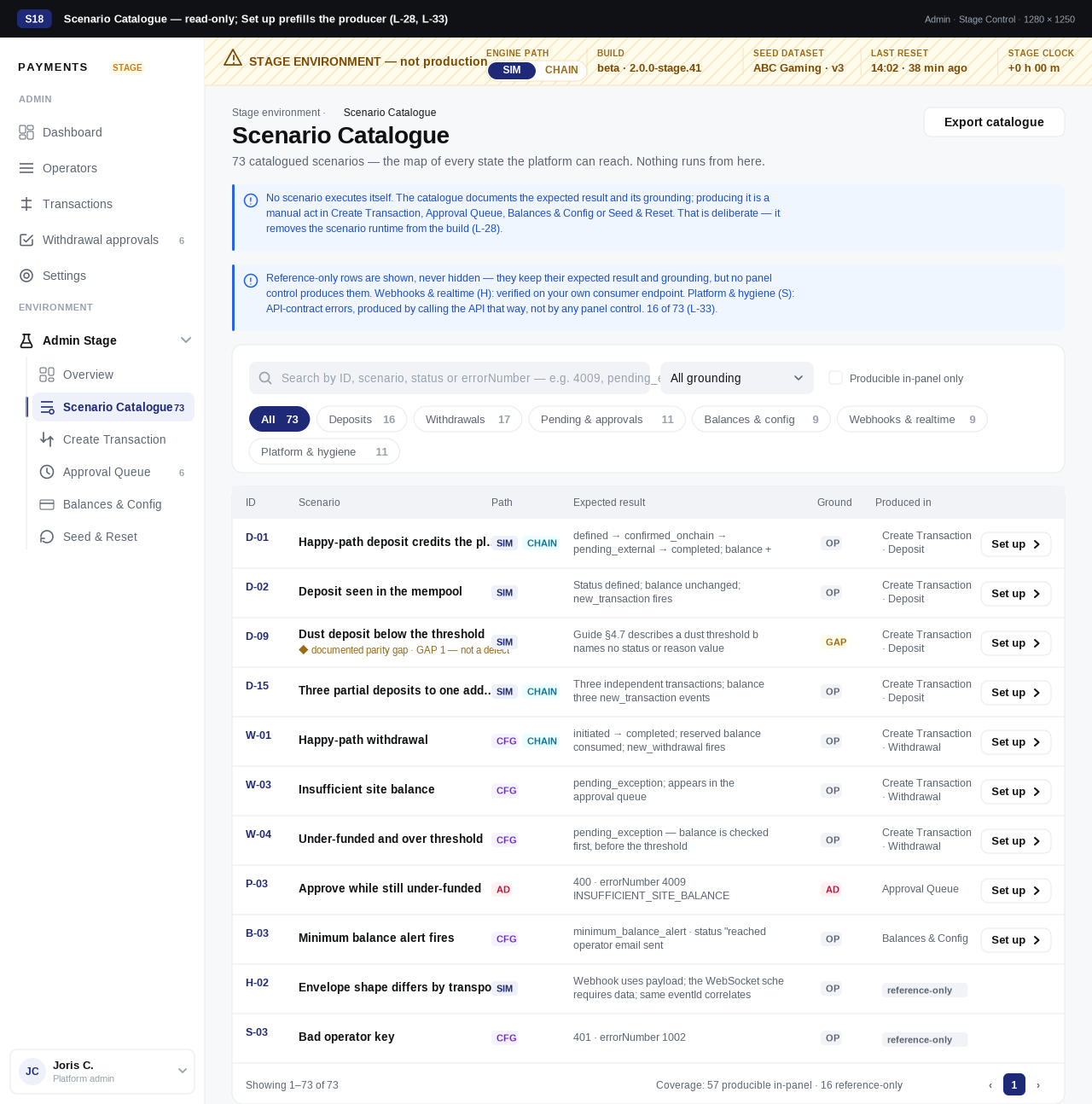
I designed a stage environment for the admin panel: a read-only catalogue of scenarios, each with its expected result and its source, and a Create Transaction form that back-solves its inputs so the chosen state is genuinely reached rather than faked. Every form mirrors the production endpoint it simulates, down to base units and the documented decision order. It is now live as the platform's stage and demo environment.
Prototypes and integration architecture
I designed clickable prototypes of the operator portal and its dashboard, and drew the API architecture an operator integrates against, so engineering, the frontend agency and operators worked from the same picture before a screen was built.
Compliance: decide who is the party before choosing the vendor
I compared screening and Travel Rule providers slot by slot (Sumsub, Notabene and Didit among them) and wrote the deposit crediting-risk policy. But the real decision was not which vendor. It was who is the party to each transfer:
| Option | For | Against |
|---|---|---|
| The platform files the Travel Rule and stores player identity | One integration for every operator | Makes the platform the regulated party on every transfer, and an identity store it was designed not to be |
| Operators bring their own providers; the platform stays out | Nothing for the platform to license or secure | Smaller operators have no provider, and the platform has nothing to offer them |
| Operators own identity and filing in their own provider account; the platform screens wallets and pushes the transfer data in | The operator stays the party; the platform adds screening and data without touching funds | Depends on the vendor’s terms and written consent; where identity lives for operators with no provider is still open |
The third option became the design, written as guardrails that must all hold, among them: no custody and no control of funds, no transfer without an authenticated operator request, the compliance layer never triggers a sale, the platform is never the Travel Rule party in its own name, and an unknown result is never shown as clean.
The result
- Delivered: the contract gap report (24 findings, two of them blockers) with its questions to engineering; integration guide v1.1 with thirteen corrections and v1.2 with eight more, then on to v1.5; the production UAT pack and its first run; answers to a live operator's integration questions within a day; the operator portal and dashboard prototypes; the integration API architecture.
- Live: the stage and demo environment, where any transaction state can be reached without moving real funds.
- Designed and scope-locked: the compliance and risk layer (KYC, KYT, Travel Rule, deposit crediting-risk policy), taken from PRD to scope lock with engineering and leadership.
There is no integration-time number to show yet, and I will not invent one. What I would track: time from sandbox key to first completed deposit, integration support tickets per operator, and webhook deliveries that fail signature checks.
What I learned
Research is not counsel. I built the first compliance drafts on regulation I had read at primary sources myself. A later review corrected eleven of my own claims, from whether a threshold applies "above" or "at or above" €1,000 to which article covers incoming transfers. Every regulatory line now carries "per research" until counsel answers, and next time counsel reads the first draft.
Find the blocking question before the third prototype. The stage environment reached its third version before the question that gated it, how the engine trusts the admin panel's login, had an answer. It shipped, but now I ask "what authenticates this?" before a screen gets drawn.
What this means for a team like yours
- An API and documentation audit: your guide checked against your specification, with the gaps that cost money listed first. It fits the PRD or spec review standalone project.
- A production UAT pack for a launch that cannot afford a failed go-live.
- A compliance boundary written down before the build: who is the party, which guardrails must hold, what counsel still has to confirm.
More on this kind of work: fintech and crypto product consultant and crypto and blockchain product studio.
More cases
Also: Two pages answered one question. I merged them. · A landing page where every claim is provable · The Shib: a magazine from zero to 50,000 subscribers.
Have a fintech or crypto product to get right?
A free 30-minute scoping call: you leave with a tier and a rough scope. Pick a slot or send a short brief.
Book a 30-minute scoping call See tiers and prices