Letting an AI agent trade without the keys to everything
How I took AI-agent trading at a crypto exchange from a vague ambition to a shipped platform: an open-source MCP server, agent sub-accounts, and an onboarding a non-developer can finish.
- Role
- Senior Product Manager, product lead for AI-agent trading
- Company
- Yellow.pro, a crypto spot and perpetuals exchange · 2026
- Team
- Backend, frontend, design, legal, marketing
- Shipped
- Local MCP server (npm), hosted MCP connector, in-app agent onboarding, docs, prompt library
The situation
Yellow.pro is a crypto spot and perpetuals exchange: centralised-exchange speed, with users keeping control of custody. I joined in 2026 as Senior Product Manager across the retail terminal, and took ownership of a track nobody had defined yet: what should "AI trading" mean for the exchange?
The constraints shaped everything. A small engineering team already committed to the core exchange roadmap. A compliance position that ruled out Yellow making trading decisions for users. And an API-key system built for developers, with five scopes and no concept of "an AI acting for me".
The problem
For users. Traders were already wiring LLMs to exchanges the unsafe way: pasting a full-access API key into a chat tool or a script. One bad prompt and the agent could touch the whole balance. And getting that far needed a terminal, a JSON config file and patience. The people most curious about agent trading were the least able to set it up safely.
For the business. An exchange lives on volume and on reasons to choose it. Agents are a new class of trader, but they were invisible: agent orders looked like any other API order, so the channel could not be measured, rewarded in competitions or reported to partners.
The real question was never "can an AI place an order". It was "what is the smallest thing a user can safely hand over".
What I did
Became the first user
Before writing requirements I connected Claude to my own account and ran live strategies at small size. That found things no document review would: how the venue treats reduce-only orders when a stop and a take-profit compete for the same position, which data an agent misreads, where an agent needs the exchange to say "no" clearly. Each one became a requirement or a docs page.
Ran the setup as three different people
A developer in a terminal, a trader using a desktop AI app, and a curious retail user on a phone. The third failed almost immediately, which set the bar for onboarding.
Laid the options side by side
| Option | For | Against |
|---|---|---|
| A Yellow-hosted trading agent inside the app | Best demo, full control of the experience | We would own the decisions and the liability; months of work; users already have an AI they trust |
| API keys and better docs only | Nearly free | Keeps the unsafe pattern; invisible volume; developers only |
| Bring your own AI over MCP, into an isolated agent account | Works with Claude, ChatGPT and others; Yellow never decides a trade; shippable in slices | Depends on a young protocol; setup differs per AI client |
Shipped local first, hosted second
| Local MCP server (npm package) | Hosted MCP (one URL) | |
|---|---|---|
| Who can set it up | Developers: a terminal, a package install, a config file | Anyone: paste a link into the AI app’s connector settings |
| Where the key lives | On the user’s machine | The exchange issues and holds it; the user approves in the browser |
| Time to ship | Weeks: a package, docs, no new infrastructure | Months: auth, approval flow, per-app onboarding, hosting |
| What it proves | That agents trade, and what they get wrong | That retail users will connect one |
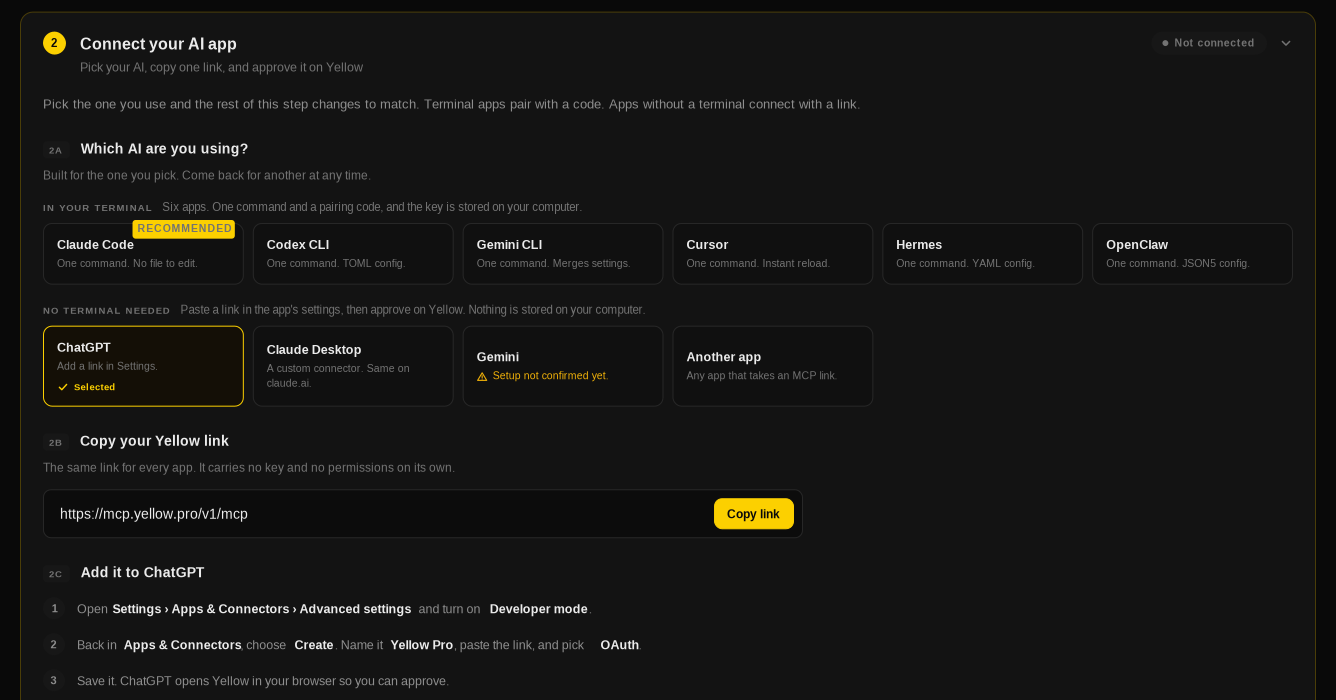
The local server went first as the proof of concept: open source, fast, and the cheapest way to learn what an agent needs from an exchange. The hosted connector followed for retail onboarding: no install, no pairing code, one link that every supported AI app accepts.
What shipped
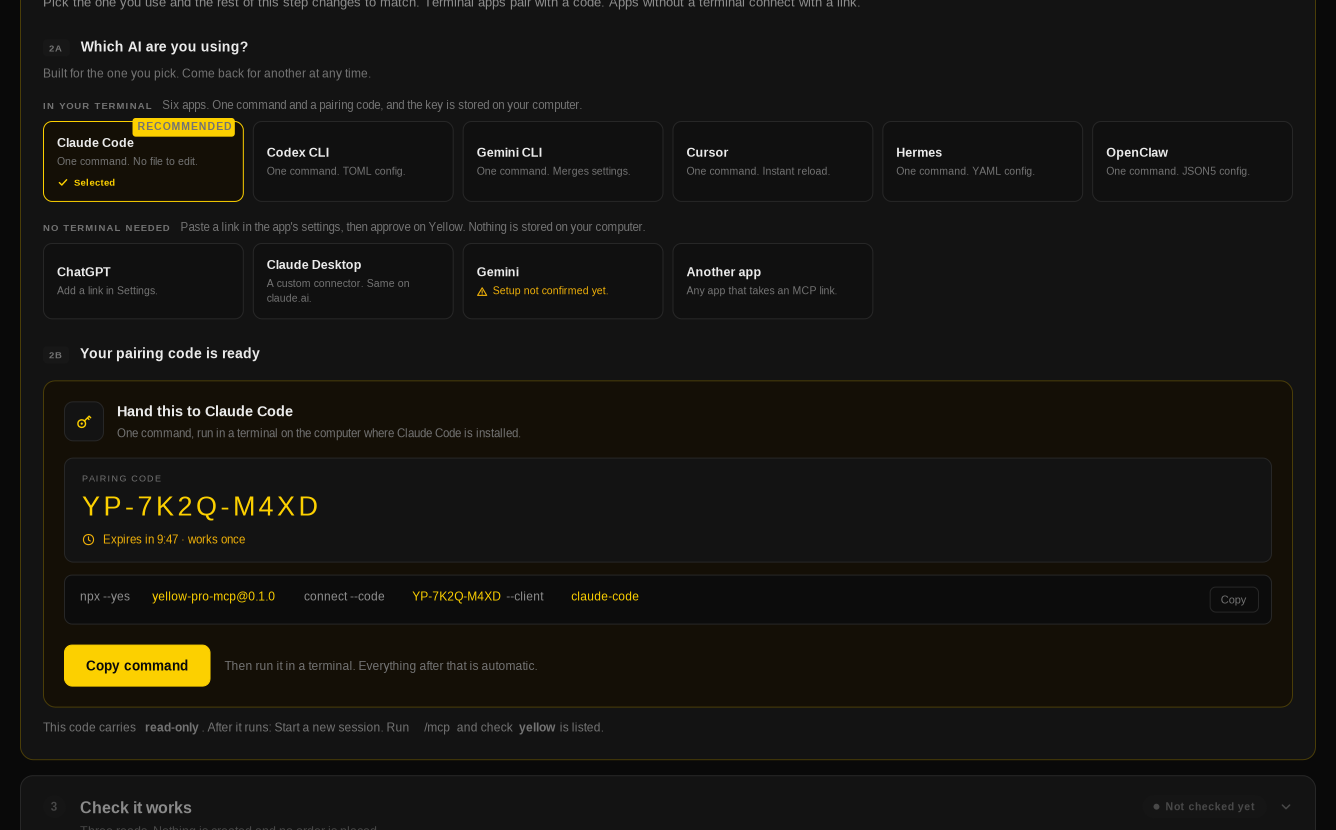
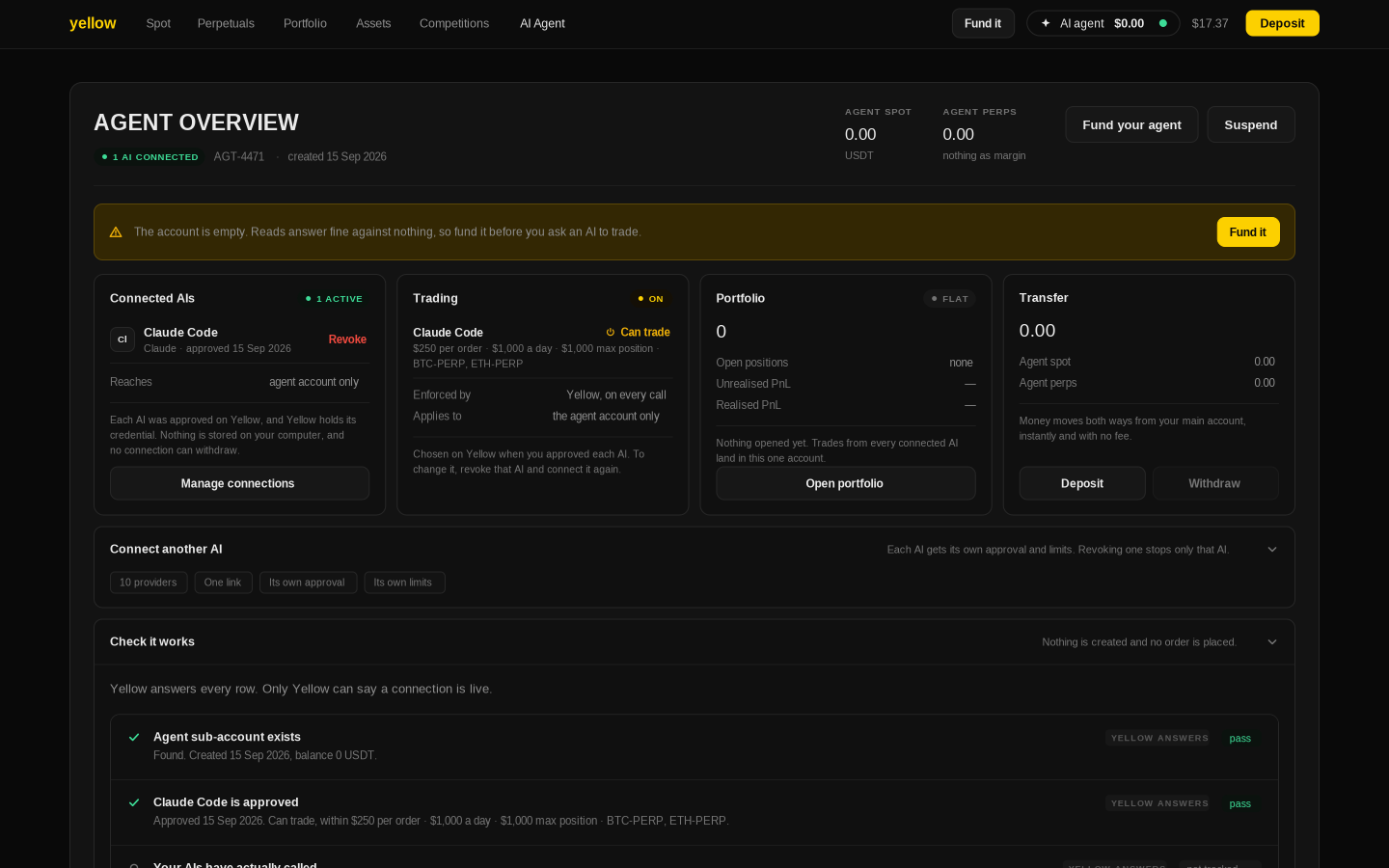
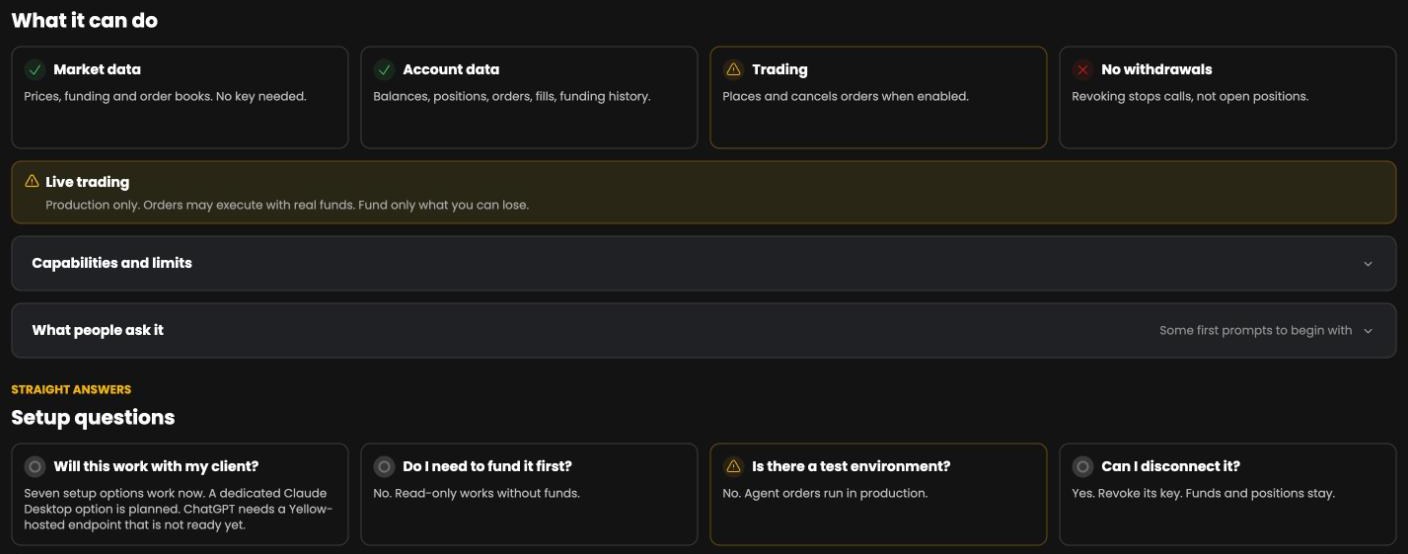
- An agent sub-account. The AI never sees the main account. The user funds the agent with what they are willing to put at risk, and takes it back the same way.
- Pick your AI. Supported AI apps, each with setup steps checked against the vendor's own documentation.
- Read-only by default. Trading is an explicit opt-in on the same screen, recorded with a risk acknowledgement. A withdrawal permission is never granted to an agent key, on any path.
- A one-time pairing code on the local server, expiring in minutes, instead of copying secrets around.
- "Check it works". Three read-only checks run before the user trusts the connection.
- One page, two modes. No agent key yet: onboarding. Key exists: an overview with revoke, the trading switch, adding funds and "connect another AI".
- Attribution. Agent volume is tagged at the source, so leaderboards, competitions and partner reports can finally see it.
Alongside the product: an open-source MCP server (market data, balances, orders, positions, funding, transfers; source on GitHub, package on npm), fifteen documentation pages, and a public library of ten strategy prompts where every order waits for the user to type "confirm".
The result
The local MCP server went public in September 2026 as the proof of concept, followed by the hosted connector for retail, and agent onboarding is live in the app. While I was there I traded through it myself most days, which remained the fastest bug-finding process the team had.
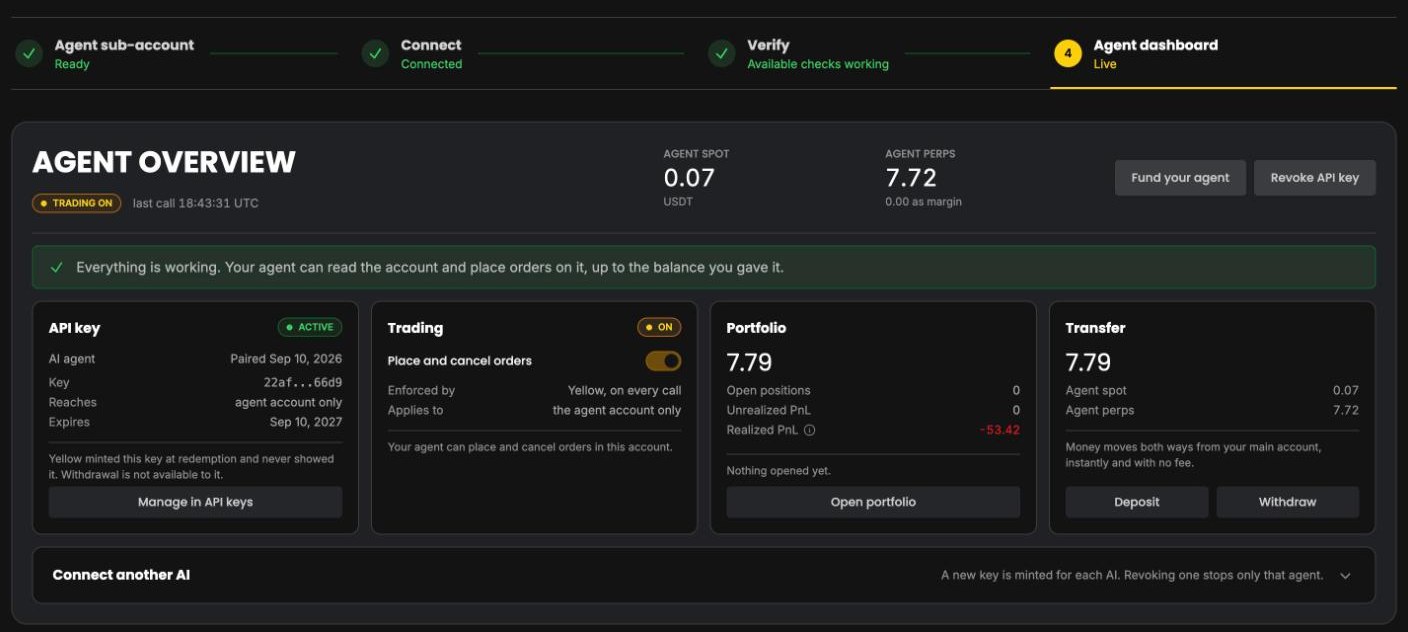
It is too early for adoption numbers, and I would rather say so than invent one. What I track: connected agents, share of volume that is agent-attributed, time from "create agent account" to first agent order, and how many users stay read-only.
What I learned
Record the reason next to the requirement. I reversed my own decision inside an hour, and it was cheap because I had written down why. I briefly changed the default key from read-only to read-and-trade to shorten the path to a first order. Rereading the risk rationale: with no spending-cap gateway at launch, the connect-time disclosure was the only control, and a read-only default is what forces every user through it. I put it back. Inverting a stated decision takes minutes; hunting an unstated one takes days.
Draw mobile first. The desktop flow was on its fifteenth version before anyone drew the phone. The two components most likely to break on a small screen were exactly the two we had polished most.
What this means for a team like yours
- You run an exchange, wallet or trading app and want to let users connect an AI without giving it everything: permissions, sub-accounts and approval flows designed before the build.
- You need to see a new channel (agents, partners, bots) in your numbers: attribution and KPIs defined before launch, not after.
- You want a clickable prototype your engineers and compliance lead can react to in a week, not a slide deck.
A Sprint fits one flow like this.
More on this kind of work: crypto and blockchain product studio.
More cases
Also: Two pages answered one question. I merged them. · A landing page where every claim is provable · The Shib: a magazine from zero to 50,000 subscribers.
Have a fintech or crypto product to get right?
A free 30-minute scoping call: you leave with a tier and a rough scope. Pick a slot or send a short brief.
Book a 30-minute scoping call See tiers and prices